
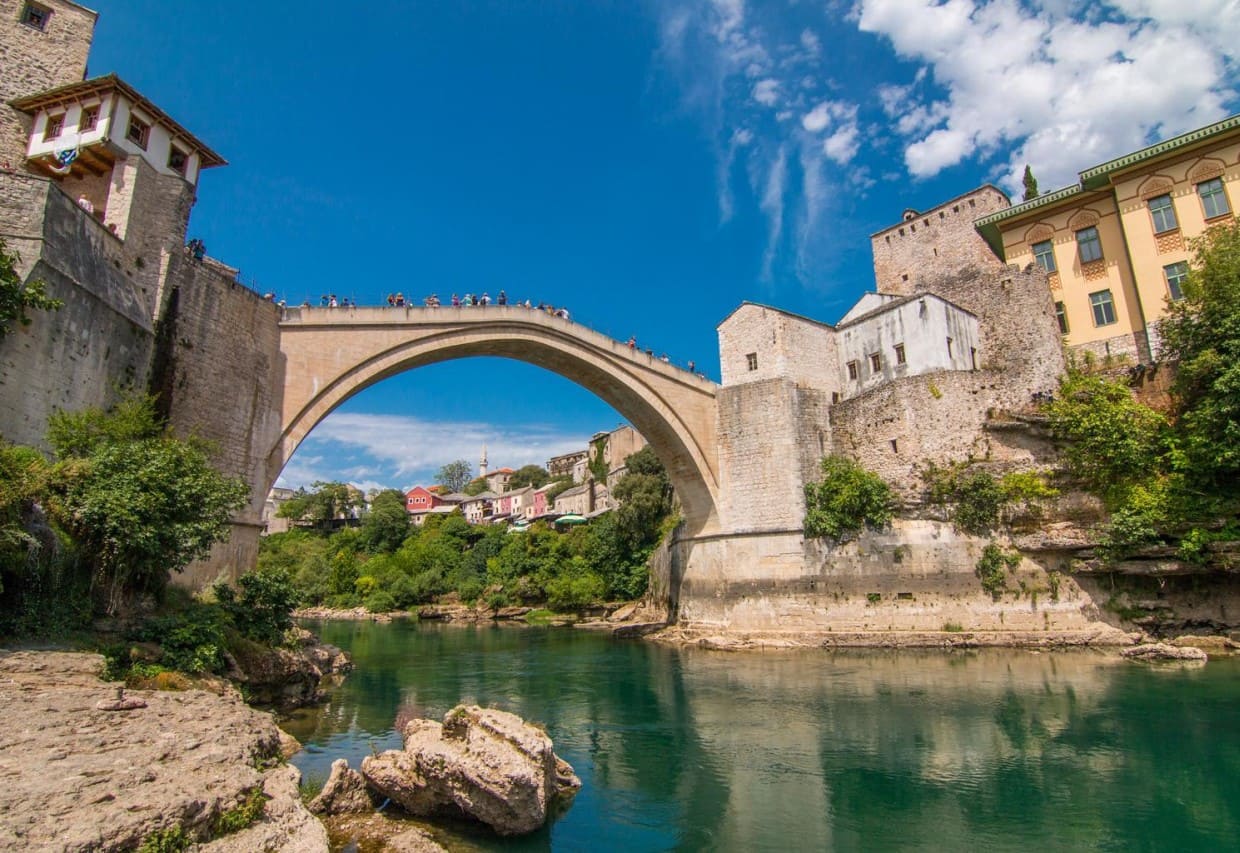
What kind of day will it be? It's the kind of trip after which you feel as if you've lived a small lifetime in just one day: changing countries, religions, landscapes and moods. You leave Montenegro and, just a few hours later, you find yourself in the most famous city of Bosnia and Herzegovina — Mostar, where the legendary Stari Most stretches gracefully over the emerald Neretva River. A little further away, by the turquoise Buna River, a quiet and slightly mystical dervish monastery in the village of Blagaj awaits you.
The tour lasts from 9 to 12 hours — enough time not just to check sights off a list, but to truly feel the atmosphere of each place. The small-group format makes the trip feel almost private: up to six people share the €270 cost, and the whole day unfolds at a comfortable pace, without crowds or big buses.
Mostar: a city where worlds meet
Mostar is often called the most beautiful and most famous city in Bosnia and Herzegovina, and when you first see its old centre, you immediately understand why. Narrow cobbled streets, old Turkish houses, the sound of church bells, the azan coming from minarets — two religions, Muslim and Catholic, have coexisted here for centuries, giving the city its very human and very warm character.
Walking through the old town, you constantly feel how it grew at the crossroads of cultures and trade routes. On a single small square, you can see a minaret, a church dome and the curved roofs of old Ottoman houses — a rare balance of East and West that both calms and sparks curiosity.
The legendary Stari Most
The symbol of Mostar is Stari Most — the 16th-century old bridge, spanning the Neretva in a beautiful, almost weightless arch. It was designed by the student of the great Ottoman architect Sinan — Mimar Hayruddin — and commissioned by Sultan Suleiman the Magnificent. Once, a shaky wooden bridge on chains stood here, but the growing city needed something truly reliable and grand.
Today, the stone arch rises about 20 meters above the river. Standing in the middle, you feel as though you're floating above the emerald water. The steps of the bridge are slightly slippery and steep, so you move slowly, stopping now and then to take photos of the old town, its colourful roofs, and the dramatic cliffs of the Neretva, which look almost painted here.
Atmosphere of the old town
On both sides of the bridge, busy market streets stretch: shops with copperwork, ceramics, embroidery, and carpets, the smell of freshly brewed Bosnian coffee and grilled meat. You don't want to pass by — you want to slow down, touch the smooth metalwork on the trays, try on a scarf or sit in the shade with a cup of strong coffee, watching new groups of tourists climb the bridge.
From one of the viewing balconies, you get the angle that usually ends up on postcards: the arch of Stari Most framed by green slopes and the Neretva River. In summer, you may see local daredevils collecting money from passersby and then diving off the bridge into the icy river — a long-standing tradition that travellers look forward to almost as much as the view itself.
Blagaj: silence at the source of the Buna River
After vibrant and lively Mostar, you head to a completely different place — the village of Blagaj. It hides at the foot of tall cliffs, where the Buna River bursts from a massive rocky wall, forming a powerful turquoise spring and small waterfalls.
Right at the water's edge, almost clinging to the rock, stands the dervish monastery — the tekke, built in the Ottoman era for Sufi orders. White walls, dark wood, low ceilings, and windows overlooking the place where the water is born straight from the stone — it feels made for silence, prayer and contemplation.
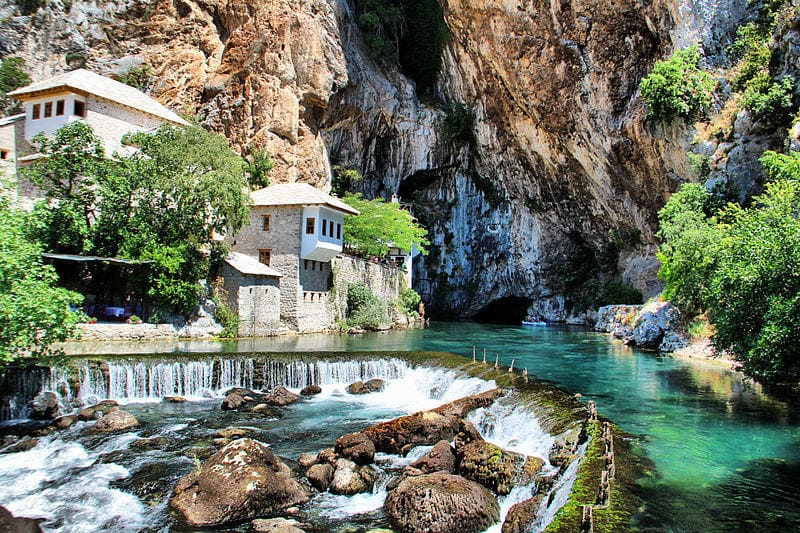
The Dervish Monastery in Blagaj
Inside the monastery, visitors can walk through the old rooms of the dervishes, look into the prayer hall, sit by the window with a view of the river and imagine how people have been coming here for centuries in search of peace. The atmosphere is soft and respectful: people of all backgrounds come to feel the place's energy and take a break from the rush.
Keep in mind the dress code: shoulders and knees should be covered, and inside, it's best to remain quiet and calm. This is not a museum in the usual sense but a living spiritual place — and that is why it leaves such a strong impression.
The Buna River: boat ride, caves and waterfalls
After visiting the monastery, you can change your perspective and see everything from the water: short boat rides along the cliffs of the Buna are available. The river is obvious and at the same time intensely turquoise — at moments it seems as if the boat is gliding over glass.
On some parts of the route, the river flows under rocky overhangs, forming small caves you can gently enter, feeling like a character in an adventure film. In a shallow area, many people swim, cooling off after a warm day, and the sound of nearby waterfalls adds a wild touch of nature that city life often lacks.
Tour format and who it's for
The tour lasts about 9–12 hours, so that the day will be full but without the feeling of rushing from point to point. The timing is planned to include everything: the drive into Bosnia and Herzegovina, a walk through Mostar with Stari Most and the old town, a stop in Blagaj, a visit to the dervish monastery, and time to relax by the Buna River with an optional boat ride and swimming.
The price of the tour is €270 per group of up to six people, making it especially convenient for families, groups of friends, or couples who want to travel in a private atmosphere. This format allows you to set your own pace: spend a little longer at a lookout point or, on the contrary, head to the river earlier.
Feelings that stay with you
This day is about contrasts and harmonies at the same time: Muslim minarets and Catholic church bells, the strict stone bridge and the soft waters of the Neretva, the lively markets of Mostar and the quiet spiritual calm of Blagaj. A journey into the heart of Bosnia and Herzegovina offers a different angle on the Balkans — not only the seaside one, but also historical, spiritual and almost cinematic.
When you return, you take with you not just photos of a beautiful bridge and an unusual waterside monastery, but the feeling that one day turned out to be unexpectedly full of meaning and stories. And perhaps, after this trip, you'll want to come back not for a tour, but for a few days — to walk across Stari Most once more and sit by the water where the Buna is born.