
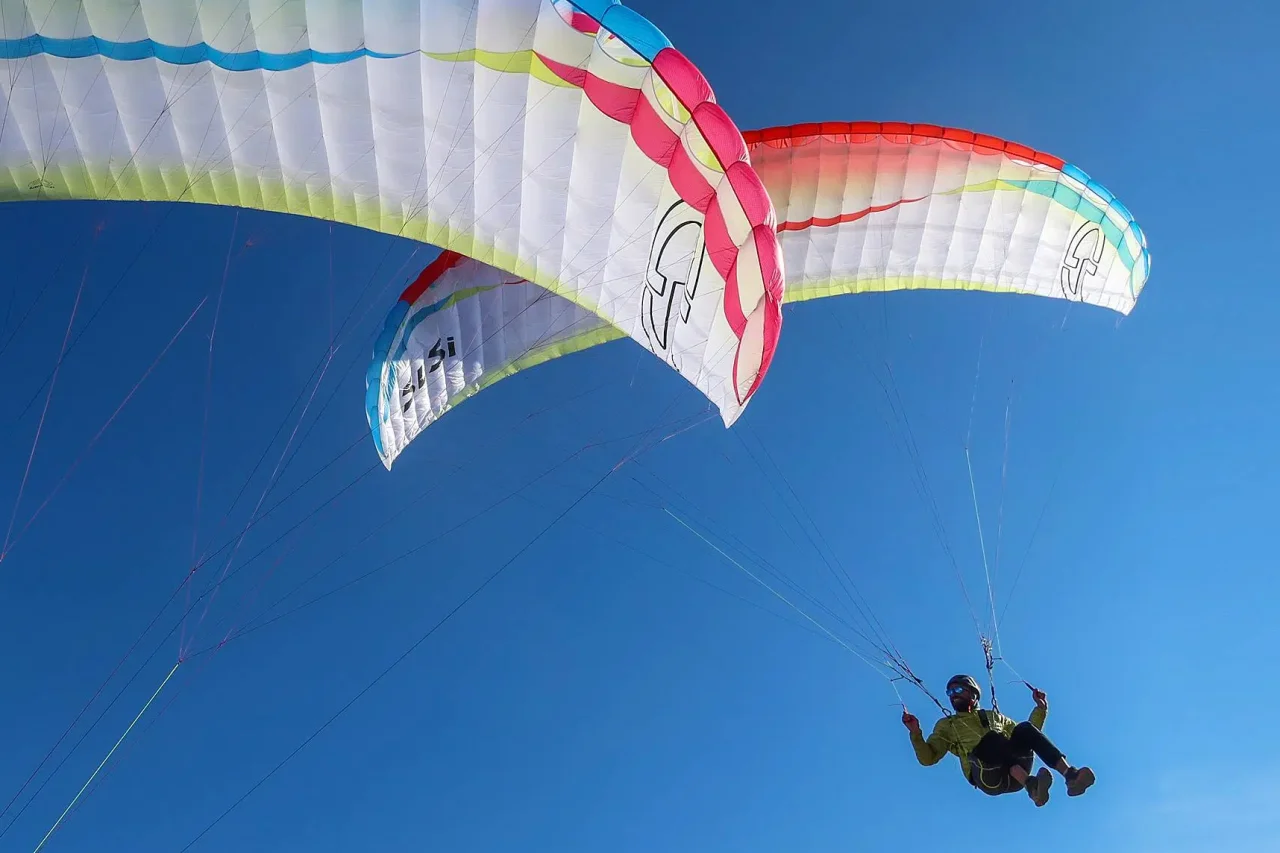
The SuSi 4 – #Superlight4all represents AirDesign’s fourth iteration in the ultra-light hike-and-fly paraglider category, designed from the ground up as an all-encompassing wing family that spans the broadest range of pilot skill and weight, certified from EN-A to EN-D depending on size and loading. This paraglider is notable for its symbiosis of lightweight simplicity, robustness, and playful agility, aiming to serve both first-time pilots and expert mountaineers with a single modular design.
Positioning and pilot spectrum
The SuSi 4 is marketed as the “superlight option for the Eazy,” AirDesign’s classic beginner EN-A wing, bridging the gap between purely hike-oriented toy wings and genuinely certified first gliders. Significantly, on many sizes such as the 18 m² and above, the glider achieves EN-A certification in standard loading, making it suitable for newcomers seeking a safe, light, and compact wing for basic flying or their first hike-and-fly adventures. Simultaneously, the wing’s extended weight ranges allow pilots to push the same size to EN-B, EN-C, or even EN-D categories. This transforms those wings into high-speed, high-loading mini-wings favored by seasoned pilots for alpine or competitive applications. The “one platform from A to D” design ethos thus differentiates SuSi 4 from competitors by offering unprecedented versatility on one wing family.
Flight behavior and performance
AirDesign emphasizes SuSi 4’s “super simple fun from A to D” character. At standard loads, the handling is accessible and offers passive safety for beginners, but the wing retains the capacity to be “fast and furious” when flown at higher wing loadings. Compared to earlier SuSi generations, the SuSi 4 improves takeoff inflation, refines roll control, and sustains canopy stability at full speed—a critical achievement for a lightweight wing that often risks nervousness in accelerated flight. The introduction of a BC-riser control system enhances pitch and roll control at speed, a welcome feature for pilots flying aggressively in mountainous and windy conditions. Performance charts indicate that at maximum loading, the wing reaches trim speeds in the mid-30s to low 40s km/h, and accelerated speeds gain an additional 17–21 km/h, reinforcing its utility as a rapid descent and strong-wind wing. Despite this, standard EN-A loadings—especially for larger sizes—preserve its identity as a safe, fun first glider for lightweight pilots and beginners interested in hike-and-fly setups.
Certification, sizes, and modularity
SuSi 4 is available in sizes ranging from 14 to 26 m², all sharing a moderate aspect ratio of 4.86 and 34 cells. This conservative design choice aligns with a philosophy of simplicity and forgiveness. The certification scheme is cleverly layered: standard weight ranges yield EN-A or B categories on larger sizes (i.e., size 18 is EN-A at 50–72 kg), while the same size can be pushed into higher categories with extended loading, up to EN-D for smaller sizes at heavier loads. This allows pilots to select a wing size and loading tailored to their weight and skill, with the assurance of genuine certification. The small sizes (starting at 14 m²) target very light pilots beginning at 50 kg total flight mass, an underserved market according to AirDesign, which proudly offers the smallest certified EN-B glider in the world.
Construction, durability, and materials
AirDesign balances the “superlight” claim with exceptional robustness. The wing utilizes double-coated Skytex fabric, reinforced seams, and added protective nose-guard patches—a direct response to fragility concerns common in ultralight wings. To reduce drag and weight, unsheathed aramid lines are used, but these are color-coded to help pilots manage line sorting and avoid tangles. A shark-nose profile reinforced with unbendable Nitinol rods (including an innovative cross shark-nose layout) stabilizes the airfoil at high angles of attack and fast speeds. Internal razor-edge seams and mini-ribs improve trailing edge aerodynamics. Practical features such as ground-attachment loops on the leading edge help prevent wing creep during challenging alpine or snowy take-offs. Pilots can choose between superlight Dyneema risers with softlinks on smaller sizes or more conventional 12 mm aramid risers on larger sizes, balancing weight savings against comfort and durability.
Weight and packability
The SuSi 4 family is impressively lightweight, with wing weights ranging roughly from 1.95 kg on the smallest sizes (with superlight risers) up to about 3.1 kg on the largest. Packed volumes are minimized thanks to the use of bend-resistant Nitinol rods and light fabric choices, allowing pilots to stow the wing compactly in small rucksacks—an important advantage for alpine and hike-and-fly pilots.
Design philosophy and market differentiation
The SuSi series originated as a personal, uncertified hike-and-fly wing for AirDesign’s founder, emphasizing lightness and direct flying sensation. SuSi 4 matures this concept with full certification, greater durability, and broader usability, but without losing the hallmark playful character. Notably, it is uniquely positioned for very light pilots with thorough certification and optimized flight behavior from as low as 50 kg, highlighting AirDesign’s “small pilots matter” focus. The brand underscores their niche expertise in small, truly certified wings, challenging competitors whose smallest sizes often lack full certification or weight-range testing.
Market feedback and expert impressions
Although independently written customer reviews are scarce due to the SuSi 4’s recent release, expert retailer and school impressions collected from various European shops and AirDesign’s official information paint a consistent and favorable picture. Users praise the wing’s unmatched versatility, bridging beginner to expert use cases and supporting a wide range of flying styles including hike & fly, expeditions, and light cross-country. Shops highlight improved takeoff behavior, enhanced glide and speed, and stability on the speed bar—the latter supported by the BC-riser system. The lightweight yet robust construction reassures pilots concerned about ultralight wing fragility. Experts also note some caveats: the wing classification varies by size and loading, demanding pilots pay attention to technical details and choose accordingly; heavier or more aggressive pilots flying smaller sizes at high loads must have suitable skills to manage the wing’s more dynamic behavior.
Conclusion for prospective buyers
The SuSi 4 emerges as a uniquely versatile, lightweight, and robust paraglider family that can evolve with the pilot’s experience from first flights through demanding mountain operations. Its combination of modular certification, durable construction, and playful yet stable handling makes it particularly attractive for light pilots and enthusiasts prioritizing a single wing for many roles. While not intended as a pure competition or XC racer wing, its balanced performance suffices for moderate cross-country flying and most mountain flying tasks. Buyers should carefully select size and loading to match their skill and intended use to fully benefit from the SuSi 4’s broad versatility. For those seeking a reliable, all-round, superlight wing with a trusted European pedigree, the SuSi 4 is a compelling choice.
For more detailed specifications and the latest updates, visit the manufacturer's website. You can also order this equipment conveniently through Paragliding4.me.